The habit app that changes the plan when the plan isn't working.
Most trackers record what you did and leave the plan alone. Monius reads the record and, once a week, proposes a change to it — one you accept with a single tap.
iPhone · iOS 26 or later · One-time purchase · No account
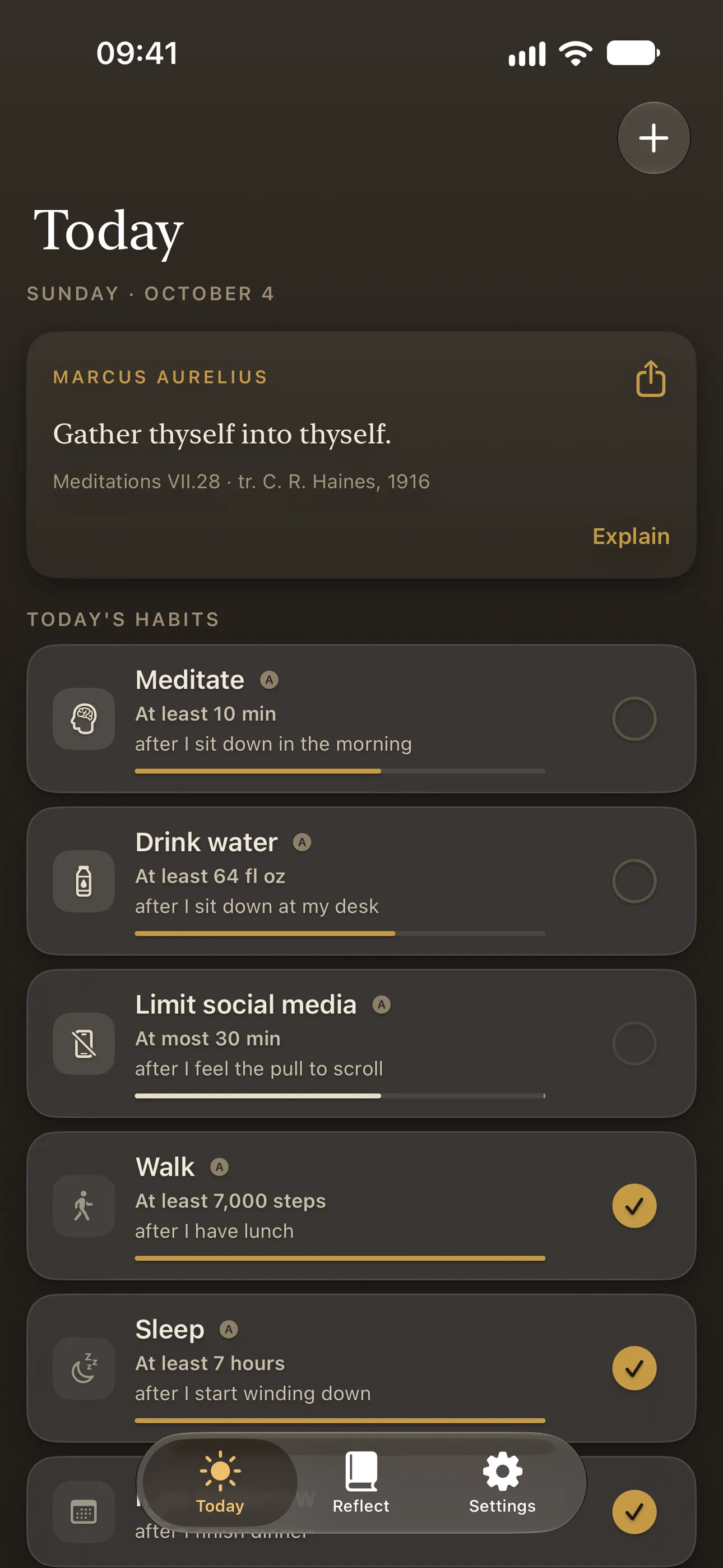
It proposes. You decide.
On Sunday, Monius reads the week you actually had and offers at most one change per habit, in plain words: raise it, ease it, or rest it. The proposal names a number — “Raise to 10 pages”, “Ease to three days a week” — so accepting it is one tap and never a form.
One raise is offered per Sunday, never several, and growth stops at two rungs in a row. A week you barely marked proposes nothing at all — a handful of marks is a week, not a verdict. And a habit's first two weeks propose nothing either: until there is a record to read, Monius only asks you to mark your days.
- Raise
- Two full weeks held. The bar moves up one rung, and only one.
- Ease
- Under target, and the week said why. The target comes down to something you would actually meet.
- Rest
- Three weeks under, already eased. Size may no longer be the question — so the habit rests instead of nagging.

No streaks. No percentages. Anywhere.
There is no completion percentage in Monius, no streak counter, and no number to break. Not as a setting you can turn off — the numbers simply do not exist in the app. Missing a day is called “unmarked”, and nothing about the interface treats it as a verdict.
- No streaks, and no streak to lose
- No completion percentage, on any screen
- No badges, no levels, no confetti
- No re-engagement notifications — only reminders you set, and an optional note when a habit completes itself
- No account, so nothing to abandon

It watches, so you don't have to remember.
Connect a habit to Apple Health or to Screen Time and it completes itself. Steps, workouts, mindful minutes, sleep, water — seventeen metrics in all. Screen-time habits work the other way: set a cap, and the app raises a shield when you reach it.
Health data syncs late and phones get left on desks, so the record repairs itself over a rolling four weeks. And because every source only ever reports a lower bound, you can always mark a day worse than the machine saw — and only mark it better where the machine could have missed something.
Yours to correct.
A day you forgot to mark is a day the record got wrong, so every past day is editable from the habit's own ribbon. Corrections are written as corrections — the app never lets a hand-tick pretend the automation fired.
That matters more here than in a tracker, because the Sunday proposal is derived from the record. If the record lies, the proposal is wrong.

Nothing leaves your iPhone.
Monius has no account and no server. There is nothing to sign up for, because there is nowhere to sign up to. Your habits, your record and your reasons live on your device, and sync between your own devices through your private iCloud — which Transcendent Creations cannot read.
Health data is read, never written. Monius asks only for the metrics your habits actually use, and it does not add or change anything in Apple Health. Screen-time usage is measured by iOS itself and never handed to the app as browsable data.
There is no analytics SDK in the app, no advertising identifier, no third-party tracker, and no crash reporter that ships your data anywhere.
Buy it once.
Monius is a one-time purchase. No subscription, no tiers, no upsell inside the app. The trial runs nine to fifteen days — long enough for two Sunday reviews, the second being the first that can propose a change — and ends on the Monday after. The review is the thing worth deciding about, and you should see it before you pay for it.
Prices vary by storefront. The App Store shows yours.
Made by Transcendent Creations.
A small independent iOS studio. If something is wrong with the app, you are emailing the person who wrote it.